

TL;DR: The US economy added 165,000 payroll jobs in October while unemployment stood at 4.1%, according to the Bureau of Labor Statistics’ November 6 release. The data complicate hopes of quick monetary easing, but the report by itself cannot establish what the Federal Reserve will do next or where Bitcoin will trade.
Bitcoin’s difficult trading week has coincided with a closely watched update on the US economy. The Bureau of Labor Statistics reported on November 6 that nonfarm payroll employment increased by 165,000 in October. The unemployment rate was little changed at 4.1%.
For cryptocurrency traders, the significance is not that payrolls have a mechanical relationship with Bitcoin’s price. Rather, employment data are one part of the evidence the Federal Reserve weighs when deciding whether inflation and economic activity justify changing interest rates.
The headline numbers tell only part of the story
The BLS said employment increased in professional and business services, healthcare, and transportation and warehousing. Professional and business services added 70,000 jobs, substantially above that category’s recent monthly average. The report also revised August and September gains upward by a combined 84,000 jobs.
Those revisions matter because monthly payroll estimates are not fixed snapshots of economic reality. More complete information can materially alter the picture after the first publication. Anyone building a large market argument on a single month should therefore examine the trend and the revisions, not only the latest number.
Average hourly earnings for private-sector employees rose by 0.4% in October and 3.1% over 12 months, according to the same release. Wage developments can affect the inflation outlook, although inflation depends on many other factors including productivity, goods costs and service-sector conditions.
Why rates matter for risk assets
When investors expect a lower path for policy rates, the relative attraction of cash and short-duration interest-bearing assets may fall, potentially supporting risk assets. A stronger labour market can complicate that narrative by giving policymakers less reason to ease quickly. But the Fed’s response depends on the whole data set, not an automatic rule that more jobs always mean higher rates.
Bitcoin is not a conventional corporate security with earnings that can be discounted using a single valuation model. Even so, it trades within financial markets where leverage costs, dollar liquidity and investor risk appetite change with the broader macroeconomic environment. That connection can become particularly visible during sharp stock-market moves.
There is also a separate institutional channel. NewsBTC reported that spot Bitcoin ETFs suffered $398.6 million in net withdrawals on November 2, reflecting flows into and out of listed investment products. Those fund numbers are useful but do not show why each investor traded.
What happens next is an open question
Market commentary has linked recent cryptocurrency weakness to technology-stock volatility and changing interest-rate expectations. That can be a plausible interpretation of contemporaneous movements, but correlation is not proof of one exclusive cause. Leverage, derivatives positioning and crypto-specific events may be operating at the same time.
The important next readings include inflation releases, future employment revisions and Federal Reserve communications. Traders should also follow the distinction between network fundamentals and investment-market behaviour explored in NewsBTC’s hashrate coverage. A shift in financial conditions can affect market prices long before it changes the underlying protocol.
For now, October’s jobs report provides a firmer data point in the interest-rate debate. It does not supply a confident Bitcoin price target or a guaranteed forecast for the next Fed decision.
This article was written by the News Desk and edited by Samuel Rae.
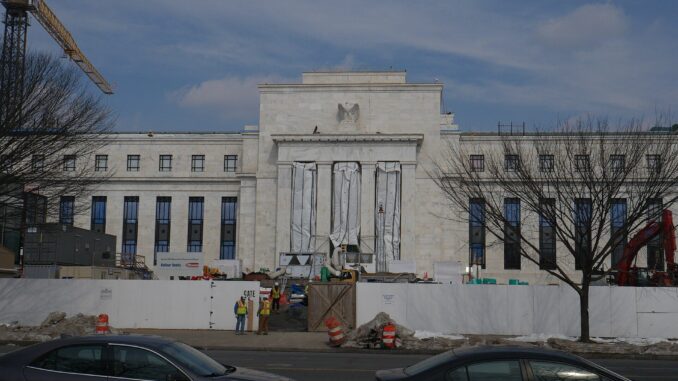
Featured image: Eccles Building (Federal Reserve headquarters) in Washington, D.C. (illustrative building photograph; report concerns Bureau of Labor Statistics jobs data and Federal Reserve policy expectations). Photo: Robert Kennicott via Wikimedia Commons, licensed under CC BY-SA 4.0.







Kommentar hinterlassen