


Key Takeaways
- Polymarket bettors give another Fed hike in October 56% odds, while a pause is still close behind at 44%.
- CME traders see a 90.1% chance rates finish above today’s range by December, with another hike firmly in play.
- Kalshi bettors put a quarter-point Fed hike on Oct. 28 at 54%, compared with 44% odds that rates stay put.
From Rate Cuts to Another Hike in One Month
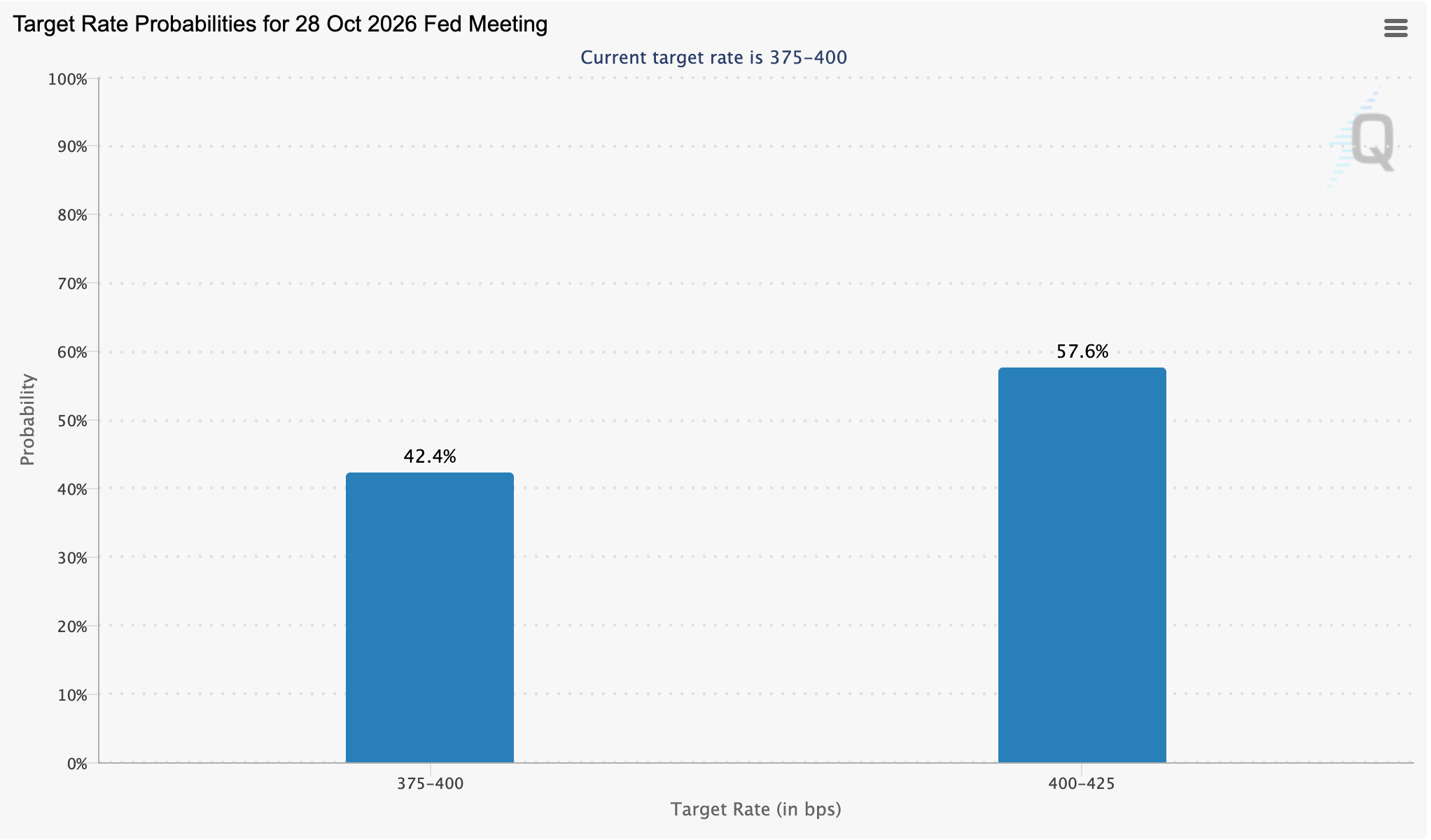
What a difference a month makes. On Aug. 19, CME futures gave the U.S. Federal Reserve a 53.6% chance of cutting rates by 25 basis points at its October meeting. Fast forward through the Fed’s Sept. 16 hike, its first increase in more than three years, and that same cut is now sitting at precisely 0%. Instead, futures traders give another quarter-point increase a 57.6% probability, against 42.4% for leaving rates alone. The really interesting part is that prediction-market bettors have independently landed in almost exactly the same place.
As of Sept. 19, 2026, Polymarket bettors currently put a 56% probability on another 25-basis-point increase at the Oct. 27-28 FOMC meeting, while a hold gets 44%. A bigger increase of 50 basis points or more sits at just 1%, and a quarter-point cut is also around 1%. More than $7.7 million has traded across the market since it opened on June 17.

Kalshi tells nearly the same story. Its roughly $1.93 million October market on Saturday gives a quarter-point hike a 54% probability and a hold 44%, while a hike larger than 25 basis points sits at 2%. Three different markets, three different ways of putting money behind an opinion, and all three are clustered within a few percentage points of one another.
Warsh Isn’t Giving Traders a Road Map
Here’s the catch. Fed Chair Kevin Warsh has gone out of his way not to promise any of this. Asked after Wednesday’s hike whether the Fed was embarking on the sort of sequence of increases that has historically followed an initial move, Warsh shut the door on an easy answer. “I’m not in the forward guidance business,” he remarked, adding that he wasn’t going to “pre-judge any future decisions we make.”
Warsh was equally blunt about the Fed’s obsession with individual economic releases. Rather than hanging monetary policy on the latest inflation print, he stated that “trends matter” and “data points are noisy.” Then he went a step further:
“Data point dependence is a dangerous preoccupation, it’s not something that concerns me.”
So traders are trying to handicap October while the guy running the Fed is basically telling them not to expect a trail of breadcrumbs.
The September Hike Changed Everything
The September meeting provides some pretty obvious clues about why the odds flipped. The FOMC unanimously raised its target range by 25 basis points to 3.75%-4%, ending 1,148 days without an increase. Warsh said the economy appeared to be strengthening and that he and his colleagues were hard-pressed to describe financial conditions as restrictive. Inflation, meanwhile, remained above the Fed’s 2% objective.
Warsh estimated the August total personal consumption expenditures inflation at around 3.6% over 12 months, with core PCE around 3.2%. He said inflation had been running above target for more than five years and put the problem in unusually plain language:
“The plain fact is that inflation is too high and has been for too long.”
The betting shift is hard to miss. CME’s October odds for a quarter-point hike stood at only 6.6% a month ago, then reached 42.5% one week ago and now sit at 57.6%. Meanwhile, the probability of a cut went the opposite direction, collapsing from 53.6% a month ago to 6.5% one week ago and now 0%.
December Is Where the Numbers Get Wild
October is still a fairly close call. December is another story. CME futures put the probability of rates being above today’s 3.75%-4% range after the Dec. 9 meeting at 90.1%. The current range surviving through December gets only 9.9%, while the probability attached to a lower range is 0%.

There’s an important wrinkle in those numbers. Futures assign a 46% probability to a 4%-4.25% target range in December and another 44.1% to 4.25%-4.5%. In plain English, the market isn’t merely entertaining one more hike. Nearly half of the probability distribution sits two quarter-point moves above today’s range by December. A month ago, that 4.25%-4.5% outcome carried just a 2.6% probability.
That is a pretty dramatic rewrite of the rate script in four weeks. In August, traders were debating how much lower rates might go. Now they’re debating how much higher.
Trump Wants the Elevator Going the Other Way
President Donald Trump, meanwhile, wants none of it. After the Sept. 16 increase, Trump argued that U.S. interest rates “should be 1%, or less, because we are the Best Credit in the World — BY FAR.” He also demanded:
“LOWER THE INTEREST RATES FOR THE UNITED STATES OF AMERICA, AND FAST!”
Trump nevertheless said he still had confidence in Warsh, whom he appointed, while directing his anger toward the rest of the Fed board. He called its members “very hostile,” “very political,” and “a bunch of politicians,” though the supplied material notes that he did not attack Warsh by name in the manner he previously attacked former Fed Chair Jerome Powell.
That creates a pretty strange setup heading into October. Trump wants rates drastically lower, Warsh refuses to telegraph his next move, inflation remains above target, and people wagering real money increasingly think another hike is in the cards.
October Suddenly Looks Like the Main Event
For now, nobody has October locked down. All the markets currently look like a coin toss. The prediction marketplace Polymarket says 56% for another quarter-point hike. Kalshi says 54%. CME futures say 57.6%. The alternative, a simple pause at 3.75%-4%, still carries enough probability to make the Oct. 28 decision a genuine toss-up rather than a foregone conclusion.
December is where traders are making the much bigger bet. CME’s 90.1% probability of rates ending above today’s range suggests the market increasingly views September not as a lonely hike, but as potentially the beginning of something larger. A month ago, traders gave an October rate cut better-than-even odds. Today, that number is zero. The Fed took 1,148 days to raise rates again. Markets are betting the next one could take just 42.







Kommentar hinterlassen