
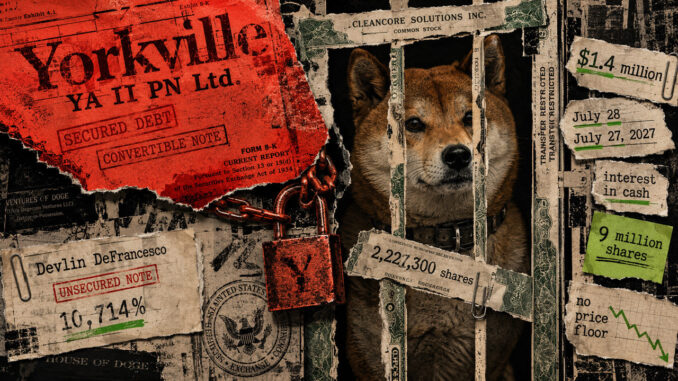

House of Doge’s wholly owned Dogecoin Ventures unit borrowed $1.4 million from lender Devlin DeFrancesco under an unsecured note, according to a July 29 SEC filing.
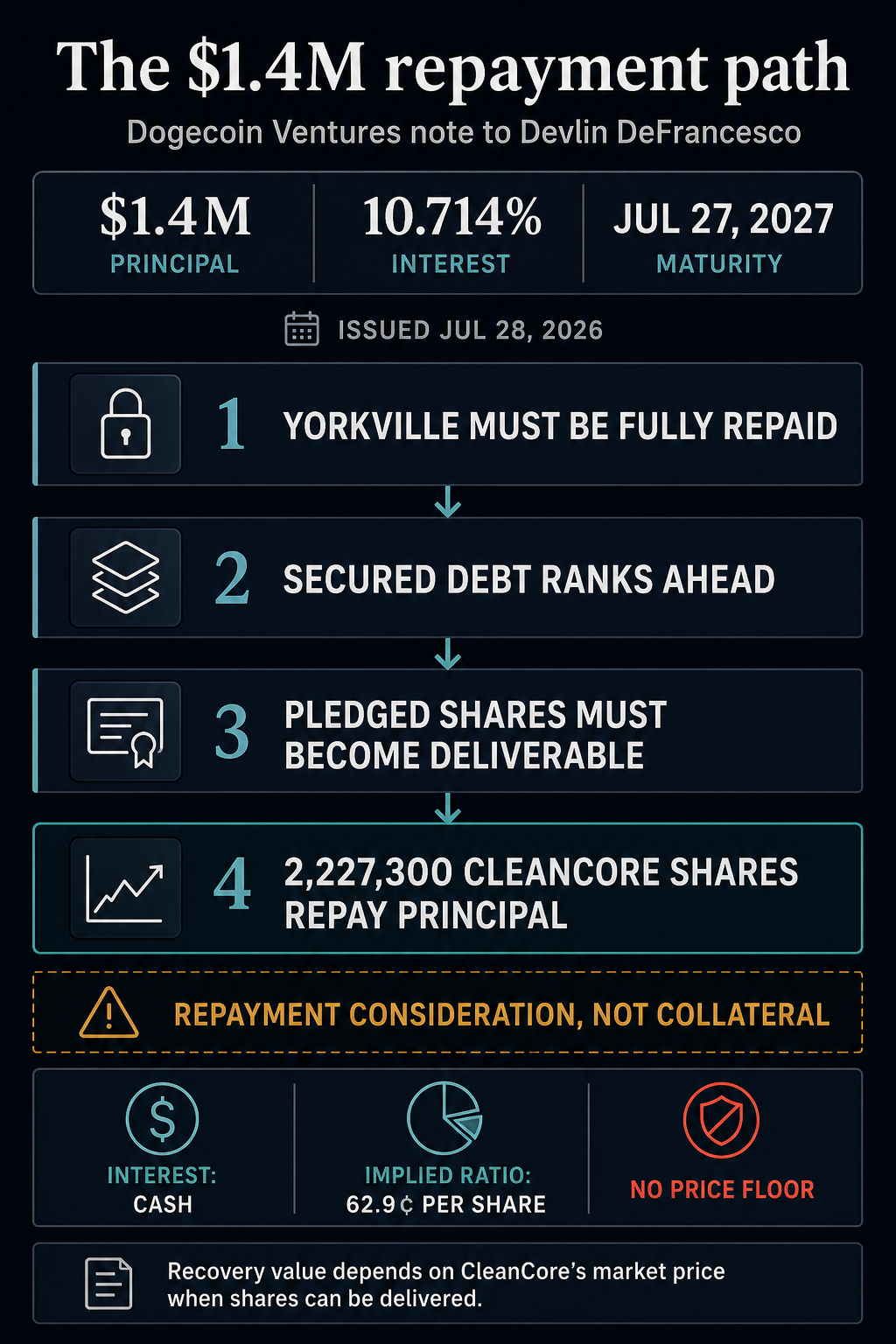
Secured creditors get paid first, while the $1.4 million principal is due in 2,227,300 CleanCore Solutions shares already pledged to House of Doge’s senior lenders.
The note was issued July 28, bears 10.7% annual interest and matures July 27, 2027. Rather than return the $1.4 million principal in cash, Dogecoin Ventures agreed to deliver the fixed block of unrestricted, registered CleanCore shares.
Dividing the face amount by that block produces an implied value of about 62.9 cents per share.
Interest is due in cash. Even if Dogecoin Ventures repays early, it must pay the full interest that would have been due at maturity.


The repayment path runs through senior creditors
The fixed-share structure leaves DeFrancesco exposed to CleanCore’s market price when the stock can be delivered. A more immediate obstacle is creditor priority: the shares are repayment consideration, not collateral for the new note.
The note says it is unsecured and expressly subordinates payment to Dogecoin Ventures’ secured debt. It separately bars scheduled or early repayment until House of Doge has fully repaid its convertible note held by YA II PN Ltd., known as Yorkville.
A June 1 amendment extended the Yorkville note’s maturity to July 31, 2026, required $100,000 of extension consideration and a $200,000 balance paydown, and placed 9 million Dogecoin Ventures-owned CleanCore shares in an account at Revere Securities. All consideration from any sale or trade of those shares was to be directed to Yorkville.



The July 29 filing leaves the repayment path hazy. It gives no July 28 balance for Yorkville and leaves open whether Yorkville had been paid off or whether the 2,227,300 shares came from the earlier 9 million-share pool.
Before the note could close, the borrower or its parent needed consent from Yorkville and majority holders in the May financing. The public record stops there. It contains no consent paperwork and no explanation of how the shares would be released, leaving both questions unresolved.


That May financing disclosure covered $2.5 million of 12% convertible notes, with $1.875 million funded after a 25% original-issue discount. The filing described the planned security as second priority behind Yorkville and senior to other debt, but said the pledge and guaranty agreements were then unexecuted post-closing deliverables. The May filing itself did not establish whether those instruments were later executed and perfected.
The July 29 filing also turns to the public parent’s legacy accounting record. House of Doge dismissed CBIZ as auditor on July 23. CBIZ’s fiscal 2025 report raised substantial doubt about the company’s ability to continue as a going concern, though it issued neither an adverse opinion nor a disclaimer. House of Doge reported no disagreements with CBIZ during fiscal 2025 or through July 23, 2026.
The filing repeated five material-weakness areas: review, approval and recordkeeping for cash disbursements; account reconciliations and journal approvals; tax accounting; complex debt or equity transactions; and cybersecurity policies. Those disclosures concern the public parent’s pre-merger Brag House period.
The merger closed June 30, when the same public parent adopted the House of Doge name and transferred legacy operations to Brag House Inc., so the historical warnings do not alone establish the combined group’s current condition.
DeFrancesco may have to wait. Yorkville must be repaid before the shares can reach him, while secured creditors remain ahead in line. The filings do not explain how the pledged stock would be released. Even then, its recovery value would move with CleanCore’s market price. The 10.7% coupon offers little shelter from those risks.







Kommentar hinterlassen