
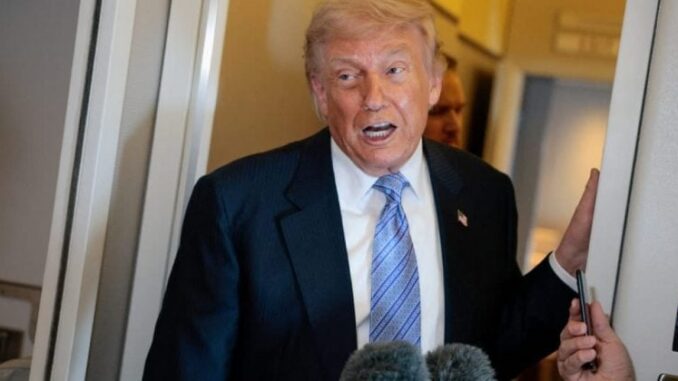

Donald Trump announced that the United States had prepared a military strike against Iran but stood down after direct appeals from leaders of Gulf nations, including the Emir of Qatar, the Crown Prince of Saudi Arabia, and the President of the UAE.
Trump framed the decision as a temporary diplomatic pause rather than a permanent retreat. He indicated that the strike had been scheduled for as soon as “tomorrow” or “Tuesday” but that he allowed additional time for negotiations aimed at producing a deal the US could accept. He also made clear that American military forces remain on high alert and ready for what he described as a large-scale assault if diplomacy collapses.
What happened and why it matters
The core issue is Iran’s nuclear program. Trump emphasized that preventing Iran from acquiring nuclear weapons remains a non-negotiable objective, and that the military option is very much still on the table. The Gulf states, which would bear the most immediate consequences of a regional conflict, apparently convinced him that a window for negotiation still exists.
The Strait of Hormuz, a narrow waterway between Iran and the Arabian Peninsula, is one of the most consequential chokepoints in global energy markets. Roughly a fifth of the world’s petroleum passes through it daily. Iran has previously pressured shipping in the strait, and any military escalation would almost certainly disrupt that flow.
The crypto angle: geopolitics as a macro input
Bitcoin and major altcoins don’t trade in a vacuum. They trade inside a global macro environment where geopolitical stability acts as a kind of background radiation. When that radiation spikes, correlations between traditionally uncorrelated assets tend to converge, and everything sells off together.
Russia’s invasion of Ukraine in early 2022 triggered a broad crypto selloff alongside equities. The common thread is not that crypto assets are directly exposed to military conflict, but that the humans and algorithms trading them reprice risk across the board when bombs start falling, or look like they might.
When geopolitical tensions de-escalate, risk appetite recovers, and crypto has historically been among the first asset classes to benefit from that relief rally. Trump’s decision to pause the strike, assuming negotiations don’t immediately fall apart, removes one source of uncertainty from the near-term macro picture.
The Strait of Hormuz factor
If you’re trying to understand why Gulf states were so eager to prevent this strike, look at a map. Qatar, the UAE, and Saudi Arabia all depend on maritime routes that pass through or near the Strait of Hormuz. A military conflict with Iran would put those routes, and their economies, directly in the crosshairs.
An oil supply shock would accelerate inflation at precisely the moment when the Federal Reserve has been signaling potential rate cuts. Higher inflation means tighter monetary policy, which means less liquidity flowing into speculative assets.
What this means for investors
The immediate takeaway is that a hot war between the US and Iran is not happening this week. But the underlying conditions that brought the US to the brink of a strike, Iran’s nuclear ambitions, regional power dynamics, and Trump’s willingness to use military force, haven’t changed.
The narrative that Bitcoin is a “safe haven” during conflicts has been tested multiple times and failed more often than it’s succeeded in the short term. In the 48-to-72-hour window around a military escalation, Bitcoin has historically traded like a high-beta tech stock, not like gold.
The variables to watch from here are straightforward. First, whether Iran agrees to meaningful concessions in the negotiation window Trump has opened. Second, whether Trump signals renewed military intent if talks stall. Third, any disruption or threat to shipping in the Strait of Hormuz, which would be the clearest leading indicator that the situation is deteriorating.







Kommentar hinterlassen