


South Korea is kicking off a pilot that will replace government expense credit cards with blockchain‑based deposit tokens.
Blockchain Goes TradFi?
The Ministry of Finance and Economy announced on an official press release that the pilot project for the execution of national treasury funds using blockchain‑based digital currency has been approved.
This new official venture marks the second time in which South Korea’s government uses digital currency and deposit tokens for the execution of national treasury funds, following another pilot project for building electric‑vehicle charging facilities and paying national subsidies together with the Ministry of Environment.
Deposit tokens are digital claims on commercial bank deposits, issued on permissioned blockchain rails, spendable by citizens and companies at participating merchants and service providers.
In simpler words, deposit tokens are digital versions of the money already kept in a normal bank account. The bank “wraps” those deposits into tokens on a private (permissioned) blockchain, and you can then spend those tokens at approved shops or service providers, just like using a card or mobile wallet.
In contrast with Central Bank Digital Currencies (CBDCs), that are digital versions of a country’s official money, created and managed directly by its central bank, deposit tokens have programmable settlement, transparent tracking of public money, and real‑time reporting for the state.
Pilot Details
The press release states that under the current National Treasury Funds Management Act, business promotion costs and related operating expenses are required to be paid with government purchase cards, effectively blocking the use of deposit tokens. Thanks to the new regulatory sandbox, those same payments can now be made with deposit tokens, creating a real‑world testbed for a new government payment and settlement method.
The new pilot is expected to serve as an opportunity to put blockchain‑based fiscal execution on a full footing and eliminate frictions in the current card‑payment setup by using blockchain’s built‑in transparency.
Quoting the press release, translated by Bitcoinist:
This pilot will allow us to preset and manage in advance the spending time and permitted business categories when business promotion expenses are executed using deposit tokens that leverage blockchain technology. This is not only expected to improve the transparency of spending but, by eliminating intermediaries in the payment structure, completely remove card‑processing fees borne by small merchants.
A Trade-Off For Traders
South Korea continues moving ahead with its Digital Asset Basic Act, a broad crypto rulebook that will set standards for stablecoins, tokenized real‑world assets, and crypto ETFs in the local market. A few weeks ago, the National Policy Committee of Korea pushed the “second‑phase” of the debate until after the June 3 local elections.
The trade‑off for South Korean traders is evident: they gain efficiency and control vs. losing some privacy and risking potential overreach. It is safe to expect tailwind for bank‑chain infrastructure, permissioned blockchain providers, and tokenization narratives.
Future “state money on chain” flows may favor bank‑issued tokens over fully open stablecoins, which could reshape liquidity, FX corridors, and on‑chain yield strategies.
If the pilot scales, South Korea could become the reference model for how blockchains handle real‑world fiscal flows.
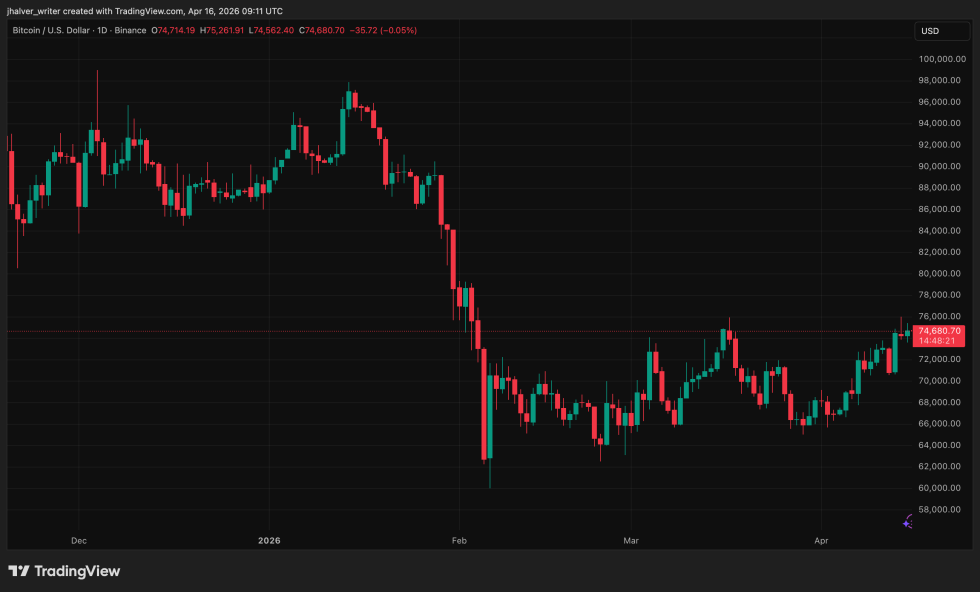
At the moment of writing, BTC trades for the highs $74ks on the daily chart. Source: BTCUSD on Tradingview.
Cover image from Perplexity. BTCUSD chart from Tradingview.


Editorial Process for bitcoinist is centered on delivering thoroughly researched, accurate, and unbiased content. We uphold strict sourcing standards, and each page undergoes diligent review by our team of top technology experts and seasoned editors. This process ensures the integrity, relevance, and value of our content for our readers.







Kommentar hinterlassen