


Ethereum is testing resistance as the market finds some relief. The price is at a decision point. And a CryptoQuant analyst has identified a supply structure beneath that resistance that has no precedent in the current cycle — and a clear one in the cycle that preceded it.
The analyst’s data reveals a 57% collapse in Ethereum’s exchange supply: reserves have fallen from approximately 35 million ETH to 14.9 million ETH — a reduction that leaves significantly less ETH available for immediate sale than at any comparable point during the 2020-2021 period. The coins have not disappeared. They have moved into the custody of holders who are not sending them to exchanges to sell.


The inflow data confirms the behavioral picture. Exchange inflows have increased recently — but the scale remains dramatically below the peaks of the 2021-2022 cycle top, when inflows approached the 10 to 20 million ETH range. The current clusters are a fraction of those peaks. Large-scale distribution — the kind that characterized the previous cycle’s top — is not present in the data.
Ethereum testing resistance with 57% less sellable supply than its previous cycle peak, and without the distribution behavior that accompanied that peak, is a structurally different test. The overhead exists. The ammunition to sustain it is historically thin.
Two Signals. One Conclusion
The analyst’s framework rests on the relationship between two independent data points that are currently moving in a configuration that has historically mattered. The first is what has happened to exchange reserves: a 57% collapse that has removed the majority of ETH’s immediately available sell-side supply from the market.
The second is what has not happened to exchange inflows: the extreme deposit spikes — 10 to 20 million ETH ranges — that characterized the 2021-2022 distribution phase have not returned. Holders are not flooding exchanges with ETH to take profit or cut losses at scale.


That combination — supply depleted, distribution absent — describes a market where the structural pressure for downside has been significantly reduced without the structural signal of panic that typically accompanies cycle bottoms at their most acute. The market is not experiencing forced selling at a scale that matches previous major lows. It is experiencing quiet.
The price context adds the final dimension. Ethereum is currently moving near the lows of previous correction ranges — the price levels that, in prior cycles, represented the zone where the risk-reward balance shifted in favor of patient capital rather than continued selling.
The analyst names this carefully: a constructive signal under current conditions. Not a confirmation. Not a guarantee. A structural alignment between depleted supply, absent distribution pressure, and historically significant price levels that, taken together, describes a market where the conditions for recovery are present even if the catalyst has not yet arrived.
Ethereum Reclaims Weekly Pivot as Recovery Tests Structure
Ethereum is trading near $2,350–$2,400 on the weekly timeframe, reclaiming a key pivot level that has repeatedly acted as both support and resistance throughout the current cycle. After the sharp drawdown earlier in 2026, ETH has staged a recovery from the $1,600–$1,800 region, where strong demand emerged and halted the decline.

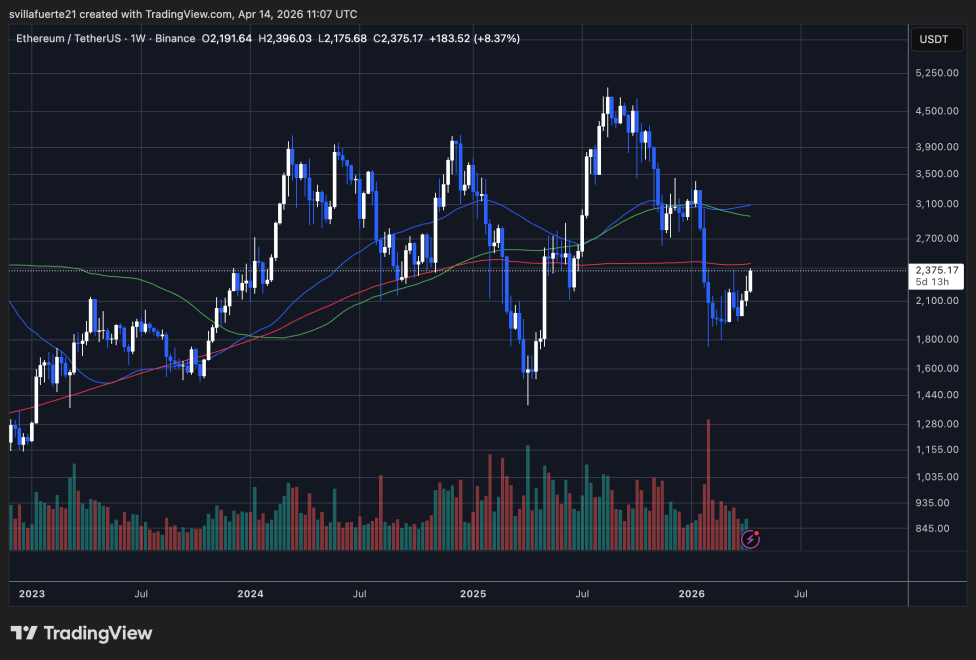
The current structure reflects a market attempting to transition back toward equilibrium. Price is now interacting with the 100-week (green) and 200-week (red) moving averages, which are converging near the $2,300 zone. This area represents a critical technical threshold: reclaiming it suggests stabilization, while failure would reinforce the broader corrective trend.
The 50-week moving average (blue) is flattening and beginning to turn upward, indicating improving short-term momentum. However, ETH has not yet established a clear higher high on the weekly timeframe, which keeps the recovery unconfirmed.
Volume patterns remain consistent with a post-capitulation environment. The spike during the sell-off indicates forced liquidations, while the subsequent normalization suggests reduced stress but not strong accumulation.
Structurally, Ethereum is at a decision point. Sustained acceptance above $2,400 would open the path toward $2,800–$3,100, while rejection would likely return price toward the $2,000 support zone.
Featured image from ChatGPT, chart from TradingView.com

Editorial Process for bitcoinist is centered on delivering thoroughly researched, accurate, and unbiased content. We uphold strict sourcing standards, and each page undergoes diligent review by our team of top technology experts and seasoned editors. This process ensures the integrity, relevance, and value of our content for our readers.






Kommentar hinterlassen