

Key Takeaways:
- BOK urged crypto exchanges to adopt circuit breakers to curb extreme volatility.
- Central bank said crypto firms lack controls compared to traditional finance standards.
- Report called for real-time systems to verify balances and prevent payment errors.
Crypto Exchange Failure Exposes Control Weaknesses
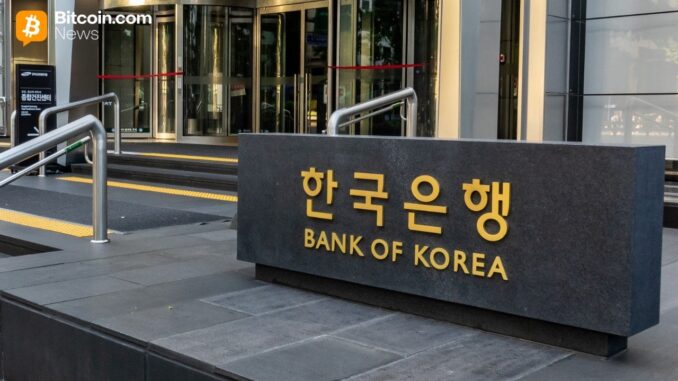
South Korea’s central bank, the Bank of Korea (BOK), said in its annual payment and settlement report on April 13 that crypto exchanges should adopt circuit breaker mechanisms following a major operational failure at Bithumb. The move signals a push to align digital asset trading infrastructure with safeguards used in traditional financial markets. The recommendation reflects mounting concern over structural weaknesses in crypto markets after a bitcoin distribution error triggered abrupt price swings and investor losses.
The report states:
“The primary cause was the lack of internal control systems designed to prevent such operational risks … Compared to traditional financial institutions, the crypto asset industry has weaker internal controls and lower regulatory standards.”
The findings highlight how operational errors, rather than market fundamentals, can drive extreme volatility in crypto environments lacking layered protections.
BOK Pushes Circuit Breakers After Bithumb Disruption
The push for crypto circuit breakers stems from a February incident involving Bithumb, one of South Korea’s largest exchanges. The platform intended to distribute bitcoin rewards worth about 620,000 Korean won (approximately $419) but mistakenly issued 620,000 BTC. Valued at around 60 trillion won, the transfer bypassed approvals and monitoring systems. No supervisory verification or automated threshold limits intervened, exposing a critical breakdown in transaction governance.
Recipients quickly liquidated holdings, triggering a flash crash and cascading liquidations. Stop-loss orders amplified the decline, while delayed detection allowed “ghost coins” to circulate for roughly 35 minutes before trading halted. The exchange’s fraud detection system failed to activate, intensifying market disruption. This sequence illustrated how internal failures can rapidly translate into market-wide stress through algorithmic trading responses.
In response, the BOK recommended adopting Korea Exchange-style circuit breakers that halt trading during extreme price swings or abnormal order volumes. It also called for real-time ledger verification systems to ensure internal balances match blockchain holdings and prevent distribution errors. Such controls would enable immediate detection of inconsistencies and limit the execution of invalid transactions.
Additionally, the central bank urged mandatory multilayer supervisory approval for high-value transactions to eliminate the risk of single-employee execution. This includes dual authorization structures and system-enforced caps tied to exchange reserves, bringing crypto platforms closer to banking-grade operational standards. The report emphasizes:
“There is a need for IT systems that can automatically and in real time verify whether internal ledgers match blockchain balances, and prevent erroneous payments caused by human error.”






Kommentar hinterlassen